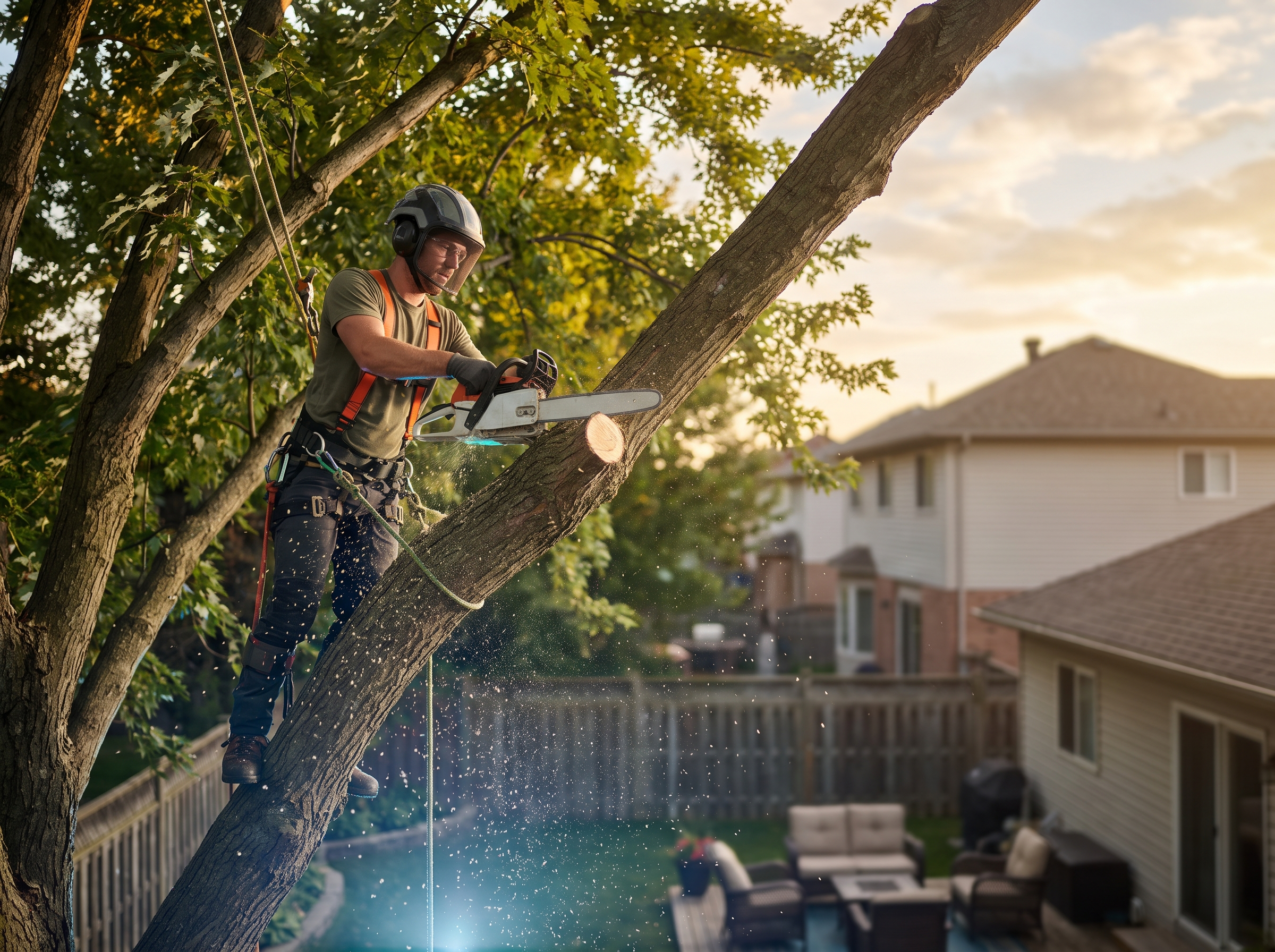
Most tree service Google Ads accounts waste money in the same three places. They lump removal, pruning and stump grinding into one campaign, they let "tree" match everything from family trees to Christmas trees, and they set a budget by guessing. This guide covers how to fix each one, and you can use it whether or not you ever hire anyone.
Split campaigns by job, not by keyword
A budget in Google Ads belongs to a campaign. If everything sits in one campaign, the cheap, plentiful clicks (usually small jobs) eat the budget before the high-ticket searches get a turn.
Build four campaigns instead:
- Tree removal. Your highest-value planned work. Includes hazardous and large-tree removal.
- Tree trimming and pruning. Smaller tickets, but many repeat customers.
- Stump grinding. Often a quick add-on, and a good upsell on removal jobs.
- Emergency and storm. Fallen limbs, trees on houses, blocked driveways. Run it only when someone can answer the phone fast. Our post on emergency tree removal marketing covers the after-hours side.
Each campaign gets its own budget, its own ad copy and its own landing page. A search for "stump grinding" should land on a stump grinding page, not your homepage.
Keywords to start with
Pick searches that sound like someone with a problem and a phone. Here is a starter set to adapt:
| Campaign | Good starting keywords | Why they work |
|---|---|---|
| Removal | tree removal, tree removal near me, remove a large tree, dangerous tree removal | Clear buying intent |
| Pruning | tree trimming service, tree pruning near me, tree trimming cost | People comparing providers |
| Stump grinding | stump grinding service, stump removal near me, grind a tree stump | Specific job, easy to price |
| Emergency | emergency tree removal, tree fell on house, storm damage tree removal | Urgent, call-driven |
Add your towns to the mix, such as "tree removal Worcester" or "tree service near Framingham". Your location pages can back those up on the website side.
Match types in plain English
Google's match types are looser than they used to be. Google defines broad match as related searches, phrase as searches including the keyword's meaning, and exact as the same meaning or intent, so exact no longer means identical text. That means "exact" can still show your ad for a close rephrasing, which is usually fine for a tree company.
If you want to use broad match, know the condition. Google's help page calls Smart Bidding critical for broad match, and the campaign setting needs a conversion-based Smart Bidding strategy. With a small account and few recorded conversions, phrase and exact are the safer starting point. See Google's match type explainer for the details.
Lock down your location settings
Tree work has a radius. A crew will not drive two hours for a single stump. Draw your targeting around the towns you actually serve.
Then check one setting most people miss. Presence or interest is the default for Search campaigns, and you have to change it to Presence yourself in the campaign's location options. Presence shows ads only to people in or regularly in your targeted locations, while presence or interest also includes people elsewhere who have shown interest in those locations. For a business that physically shows up at the property, Presence is the better fit. More detail is in this location targeting breakdown.
Negative keywords: the tree-specific list
The word "tree" is a trap. Negative keywords keep you from paying for the wrong meaning of it.
Start with these groups, then trim anything you actually offer:
- Job seekers: jobs, hiring, careers, salary, apprenticeship, training, course, certification, school
- DIY and equipment: rental, for sale, chainsaw, wood chipper, bucket truck, stump killer, how to
- Wrong kind of tree: family tree, Christmas tree, palm tree, tree house, tree of life
- Services you don't offer: lawn care, firewood (if you don't sell it), tree planting or nursery (if you don't do it)
- Wrong place: towns outside your radius that keep showing in the search terms report
Match types for negatives work differently than for regular keywords. Broad match negatives block a search only when all the negative terms are present in any order, phrase match needs the same order, and exact match needs the precise query. Also, negative keywords do not match close variants, so variants must be added separately. Add "job" and "jobs", "rental" and "rentals".
Be careful with single words that have a good side. A negative on "cost" would block people asking about price, who are often your best leads. For ambiguous words, default to phrase or exact rather than broad.
Where to put them
Put universal blocks (jobs, hiring, family tree) in a shared list. You can add up to 5,000 negative keywords per list, and create up to 20 negative keyword lists in your account. An account-level list automatically applies to all search and shopping inventory in relevant campaign types. Details are in Google's negative keyword list help page.
Put job-specific blocks at the campaign level. For example, add "removal" as a negative on your stump grinding campaign only if you want those searches going to the removal campaign instead.
The weekly search terms check
This is the habit that matters most. Once a week, open the search terms report, sort by cost, and read what people actually typed. You can use the search terms report to get ideas for negatives.
For each term, ask:
- Is this someone who could hire me for a job I do?
- Is it in my service area?
- Did it produce a call or form? If it spent money with nothing back after a reasonable number of clicks, block it.
Twenty minutes a week beats a big cleanup every quarter.
Setting a budget that makes sense
Skip the "industry average" numbers and use your own math. Here is a hypothetical, with numbers you should swap for yours:
- Say a click costs you $10.
- Say 1 in 10 clicks turns into a call or form. That is $100 per lead.
- Say you book 1 in 3 of those leads. That is $300 per booked job.
- Say an average removal job brings in $1,800.
On those numbers, you would be paying $300 to land an $1,800 job. If the same math on stump grinding gives you $300 to land a $350 job, that campaign needs a better offer or a lower bid, not more budget.
Two budget facts to know as of 2026. Google can spend up to twice the average daily budget on a busy day, and it won't bill more than 30.4 times that budget across a calendar month. So a $50 daily budget can have a $100 day, but the month tops out at $1,520. Plan around the monthly number. This explainer walks through it.
Also think seasonally. Storm weeks can spike demand for emergency work, so leave room in that campaign. Pruning and stump work tend to be more spread out through the year, so a steadier budget there is reasonable.
Phone calls: use call assets
Tree customers often call instead of filling out forms, so phone tracking matters. Google is removing the option to create new call-only ads in February 2026, and all existing call-only ads will stop receiving impressions in February 2027. To keep generating phone leads, you must use call assets within responsive search ads. See Google's transition notice.
Whatever format you use, set up call tracking so you know which campaign produced the ring. Our post on tracking where your leads come from shows how. And answer fast or text back right away, as covered in speed to lead for home services and missed call text-back setup.
Don't forget the landing page
Ads only buy the click. The page decides whether it becomes a call. A good removal landing page shows your service area, photos of real jobs, your phone number at the top, and an easy estimate request. For ideas on what builds trust, read tree service website trust signals. Our web design for hardscaping and tree service page covers the site side.
Should you also run Local Services Ads?
Possibly. Google's list of eligible home services includes tree services. If your trade has job types on the list, you can apply, pass Google's checks and pay for leads instead of clicks. Eligibility and requirements can vary by area and change over time, so check inside your own account. Our comparison of Google Local Services Ads vs. Google Ads explains how to decide.
How RGS helps
If you'd rather not manage keywords, negatives and budgets yourself, our Digital Marketing service is built for local service businesses like tree companies. We can set up the campaigns, tracking and weekly search term reviews, and connect the leads to a follow-up system using CRM build and management. See how we work with the hardscaping and tree service trade, or contact us at (617) 877-5608.