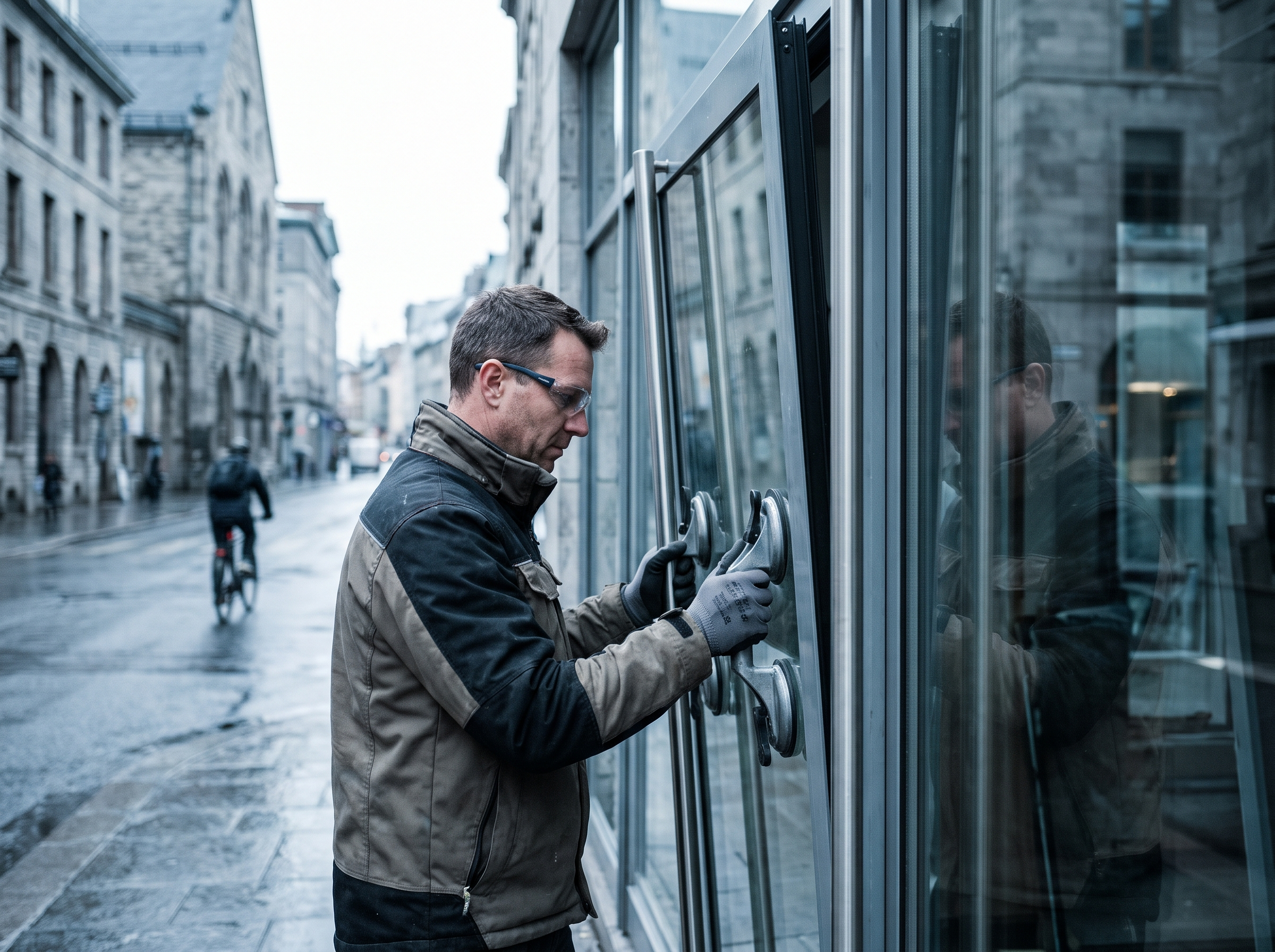
Most glass calls start the same way: "I've got a cracked window, how much?" You can't answer that by phone, and driving out to every caller wastes hours. A photo estimate process lets you screen the job, give a realistic range, and only roll a truck when the job is real.
This post covers what photos to ask for on windows, shower doors and mirrors, what to say in the text, and where photos stop being enough.
Why photos beat a phone description
Callers describe glass badly. "Double pane, kind of foggy" could be a failed seal on a vinyl window, or it could be a wood sash that needs a full unit. "Frameless shower door" often turns out to be semi-frameless with a header.
Photos fix most of that before you leave the shop. Say you run 10 estimate visits a week and 4 of them end with "can't help" or "customer went elsewhere." At an hour each including drive time, that's 4 hours a week spent on jobs that never started. A good photo screen won't remove all of those, but it will catch the obvious ones.
It also helps with after-hours calls. If you take emergency board-ups, our post on emergency glass repair leads after hours covers that side of the phone.
What to ask for, by product
Generic "send me a picture" texts get you one blurry shot from across the room. Tell people exactly what you need.
| Product | Photos to request | What you're trying to learn |
|---|---|---|
| Window (insulated unit) | Whole window from inside, whole window from outside, close-up of the frame corner, the fogged or cracked area, a tape measure across the width | Frame material, sash vs. fixed, whether this is a glass-only swap or a full unit, rough size |
| Shower door | Whole enclosure straight on, hinges and handle, the track or header, the bottom sweep, the corner of the glass | Frameless, semi-frameless or framed; swing or slider; hardware that needs replacing |
| Mirror | Whole mirror on the wall, all four edges, how it's mounted, a tape measure across the longest side | Size, edge type, framed or glued, whether it's removable without damage |
| Tabletop or patio door glass | Full door or table, edge profile, label or etched mark | Whether it's safety glass, glass type, thickness |
Add one line to every request: "Put a tape measure or a dollar bill in at least one shot." Scale in a photo catches a lot of "that's bigger than I thought" problems.
The text to send (copy and edit)
Keep it short and numbered so people can follow it on a phone.
- Open with who you are: "This is [Name] at [Shop]. Happy to give you a price range from photos."
- Ask for 3 to 5 photos, listed by product as in the table above.
- Ask for the address or town, so you know if it's in your service area.
- Ask about timing: "Is it open to the weather or just cracked?"
- Tell them what happens next: "You'll get a range today. A final price comes after we measure on site."
Step 5 matters. It sets the expectation that a photo estimate is a range, not a contract, and it saves you an argument later.
What you can and can't quote from photos
You can usually quote:
- A price range for common sizes of standard glass or mirror
- Whether the job is glass-only or a full unit replacement
- Hardware replacement for a shower door where the model is clear
- A rough lead time
You shouldn't commit to:
- A final price on custom tempered, laminated or insulated glass
- Anything that depends on a size you're guessing at
- Whether the frame is square and sound under the paint or caulk
Tempered glass is the big one. It's heat-treated after it's cut, so it can't be trimmed or drilled afterward. That's why shower doors and similar custom pieces need a field measure before you order. Codes also limit what you can swap in. Model residential code requires safety glazing (tempered or laminated) in hazardous locations such as doors, glass near doors, and shower and tub enclosures. This overview of IRC R308 lists the locations. The model code is a starting point, so confirm what your local building department has adopted before you quote a replacement that might trigger it.
A useful rule to put in your quote text: "Photo estimates are ranges and subject to on-site verification." Say it plainly and put it in writing.
The texting rules that matter in 2026
If customers text you photos and you reply from your own phone, that's one-to-one conversation. Once software sends the texts, such as automatic replies or a photo-request that fires when someone fills out a form, you're in different territory.
- Carrier registration. As of 2026, A2P 10DLC registration is required before you can send business texts from software over a standard 10-digit local number, and carriers block unregistered traffic. We cover the steps in our A2P 10DLC guide for small businesses.
- Consent. Under the TCPA, marketing texts sent with automated technology generally need prior express written consent. Purely informational texts, like "send photos so we can price your job," are generally held to a lower standard of consent, as long as they contain no promotional content.
- Opt-outs. Honor STOP requests right away, and keep a record of when a customer gave you their number and why.
Rules like these change and vary by state, so treat this as a checklist to raise with whoever sets up your texting, not legal advice.
From text to quote: a workflow that doesn't live in your camera roll
The failure point isn't the first text. It's the 15 photos sitting in someone's phone with no name attached. Here's a workflow that holds up:
- One intake link. Instead of asking customers to text photos (MMS often compresses images), send a link to a short form. It asks for product type, address, three to five photos, and a rough size. The customer's photos arrive full resolution and already sorted.
- A job record. Each submission creates one record with the photos, the contact and the product type. No hunting through threads.
- A quote sheet. Whoever prices the job sees the photos next to the fields they need: glass type, estimated size, hardware, whether safety glazing is likely.
- A range goes back fast. Speed counts here. See speed to lead for home services for why the first shop to reply tends to get the call.
- A follow-up if they go quiet. A range with no answer is the most common place a job dies. Use the approach in our estimate follow-up sequence.
- A field measure for anything custom. Book it from the same record, so the measure tech sees everything the office already knows.
If you want to price off a calculator for simple jobs like standard mirrors, our post on an instant quote calculator for your website shows where that works and where it doesn't.
Common mistakes
- Asking for too few photos. One shot is rarely enough. Give a list.
- Quoting a single number. Give a range with the assumptions stated.
- Skipping the label check. Whether glass is already safety glazing affects what you can legally replace it with.
- Letting photos pile up in text threads. Move them into one record per job.
- Promising a date before the measure. Custom glass has lead time. Say so up front.
How RGS can help
If you'd like a photo-intake form and quote sheet built around the way your shop prices windows, shower doors and mirrors, that's the kind of work our Custom Tool Building service is for. We build for local service businesses in Massachusetts and New England, and you can see how we think about glass shops on our glass and glazing page. For the plumbing behind the process, see CRM for glass and glazing and AI automations for glass shops. If you're not sure what a custom tool would even involve, start with what a custom business tool is, or call (617) 877-5608.