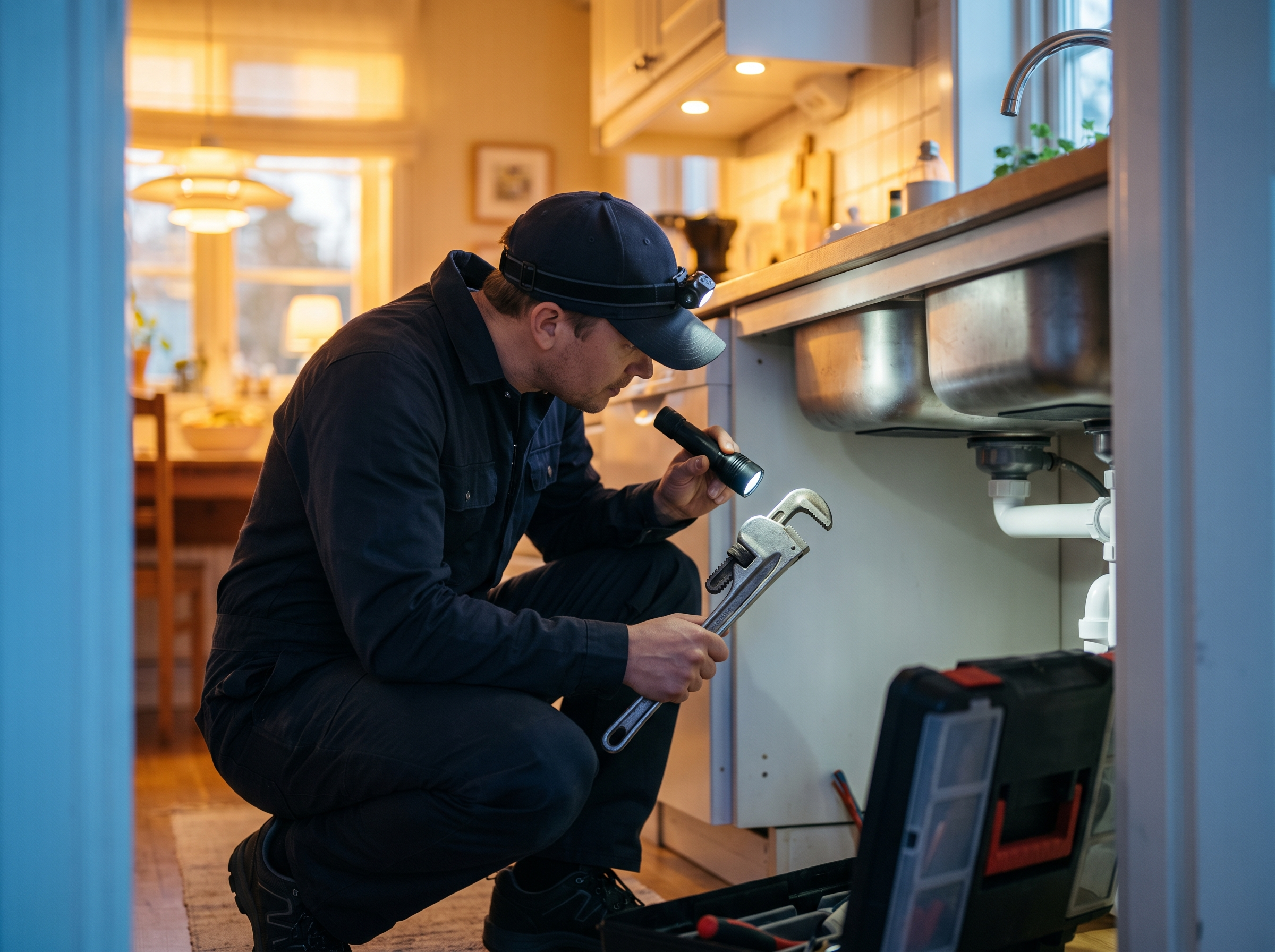
A missed call doesn't feel like much in the moment. You were under a sink or in a panel, your hands were full, you'll call back later. But for a plumbing or electrical shop, those calls add up to real money over a year. This post shows you how to calculate your own number, why voicemail doesn't solve it, and the setup that catches more of those calls.
Calculate your own missed-call cost
Don't trust anyone's industry average, including ours. Run the math on your own phones. You need four numbers.
- Missed calls per month. Pull a month of call logs from your phone provider or call tracking system. Count calls that weren't answered. Remove spam, robocalls and repeat attempts from the same number.
- Share that were real job inquiries. Listen to voicemails or call a sample back. Some will be vendors or existing customers.
- Your close rate on answered job calls. Of calls you do answer, how many turn into a booked job?
- Average ticket. Your average invoice for that type of call.
Then multiply. Here's a hypothetical for a small plumbing shop:
| Input | Example |
|---|---|
| Missed calls per month (after removing spam) | 40 |
| Share that were new job inquiries | 50% |
| Missed job inquiries | 20 |
| Close rate on answered job calls | 60% |
| Average ticket | $450 |
| Revenue at risk per month | 20 × 0.6 × $450 = $5,400 |
| Revenue at risk per year | $64,800 |
Not every missed caller is lost. Some leave a voicemail and wait. But even if you recover half of them today, the gap is large enough to justify fixing. Plug in your own numbers. If yours are small, great. You've learned that and can focus elsewhere.
Why voicemail doesn't fix it
Voicemail assumes the caller will wait. In an emergency trade, many won't. Someone with water coming through the ceiling or a burning smell from an outlet is going to keep dialing until a person answers.
There's research on how fast interest fades. In a Harvard Business Review article on online sales leads, the authors reported that firms contacting a lead within an hour were nearly seven times as likely to qualify it as firms that waited even an hour longer, and that only 37% of the 2,241 US companies they audited responded within an hour (HBR, "The Short Life of Online Sales Leads," 2011). That study looked at web leads, not phone calls to plumbers, but the lesson carries over: interest decays quickly, and the first company to respond has an edge. Our post on speed to lead for home services goes deeper.
If you run Google Local Services Ads, missed calls cost you twice. As of 2026, Google's help page says a missed call during your business hours is charged as a lead if the caller stays on the line for more than 20 seconds (Google Local Services Ads Help). You can pay for the lead and still lose the job.
The fix, in layers
You don't need to rebuild your phone system in a day. Each layer catches some of what the previous one misses.
- Missed-call text-back. When a call goes unanswered, the caller gets a text within seconds: "Sorry we missed you, this is Mike's Plumbing. We're on a job. What's going on and what's the address? We'll get right back to you." Many callers will text back details, and now you have a written lead instead of a hang-up. Full setup in our missed-call text-back guide.
- Smart routing. Ring the office first, then the owner's cell, then the on-call tech, before the call ever hits voicemail. Set different rules for business hours and after hours.
- AI call answering for overflow and after hours. An AI agent answers, takes name, address and the problem, asks whether it's an emergency, and either books a slot on your calendar or alerts the on-call person. See AI receptionist for contractors for what to look for.
- Every call lands in the CRM. Whatever answers the call, the result should be a contact and an open lead with a follow-up task, not a voicemail in someone's phone.
Before turning on any texting, confirm your number is registered for A2P 10DLC. As of 2026, US carriers can filter or block unregistered business texts. Our A2P 10DLC registration guide walks through it.
What this looks like at 7 p.m.
A homeowner calls about a leaking water heater after dinner. Your office is closed. Instead of voicemail:
- The call routes to an AI agent, which answers with your business name.
- It confirms the address, asks what's happening (leaking from the tank or a fitting, is water still running, is the gas or power still on) and whether they've shut off the water.
- It offers the first slot tomorrow morning and books it, or, if your rules say a leaking tank is an emergency, it texts your on-call plumber with the details and tells the homeowner to expect a call within a set time.
- The homeowner gets a confirmation text. The lead lands in your CRM tagged "after hours, water heater."
The homeowner has no reason to keep dialing other companies. The next morning your office sees exactly what came in overnight.
Electricians: same problem, different triage
Electrical calls split into three types that need different handling:
- Safety issues (burning smell, sparking, partial power loss) need immediate routing to a person, and the agent should tell the caller to cut power at the panel if it's safe and call 911 if there's smoke or fire.
- Service calls (dead outlets, tripping breakers) can be booked directly.
- Project inquiries (panel upgrades, EV chargers, generators) need an estimate visit and a follow-up sequence.
Write those rules down before you set up any automation. The software only follows the logic you give it.
How to measure the fix
Track these monthly, before and after:
- Missed calls (should stay similar, but now get a response)
- Texted-back callers who replied
- Replies that became booked jobs
- After-hours calls answered and booked
- Revenue from jobs that started as a missed call
If a missed call that became a booked job can be traced in your CRM, you'll know exactly what the setup is worth.
How RGS helps
We build missed-call text-back, call routing and AI call answering that books on your calendar or alerts your team in real time, all connected to your CRM so every call becomes a tracked lead. Every agent has a handoff path to a person. Learn more on our AI Services & Automations page, or see the trade-specific setups for plumbing and electrical businesses.