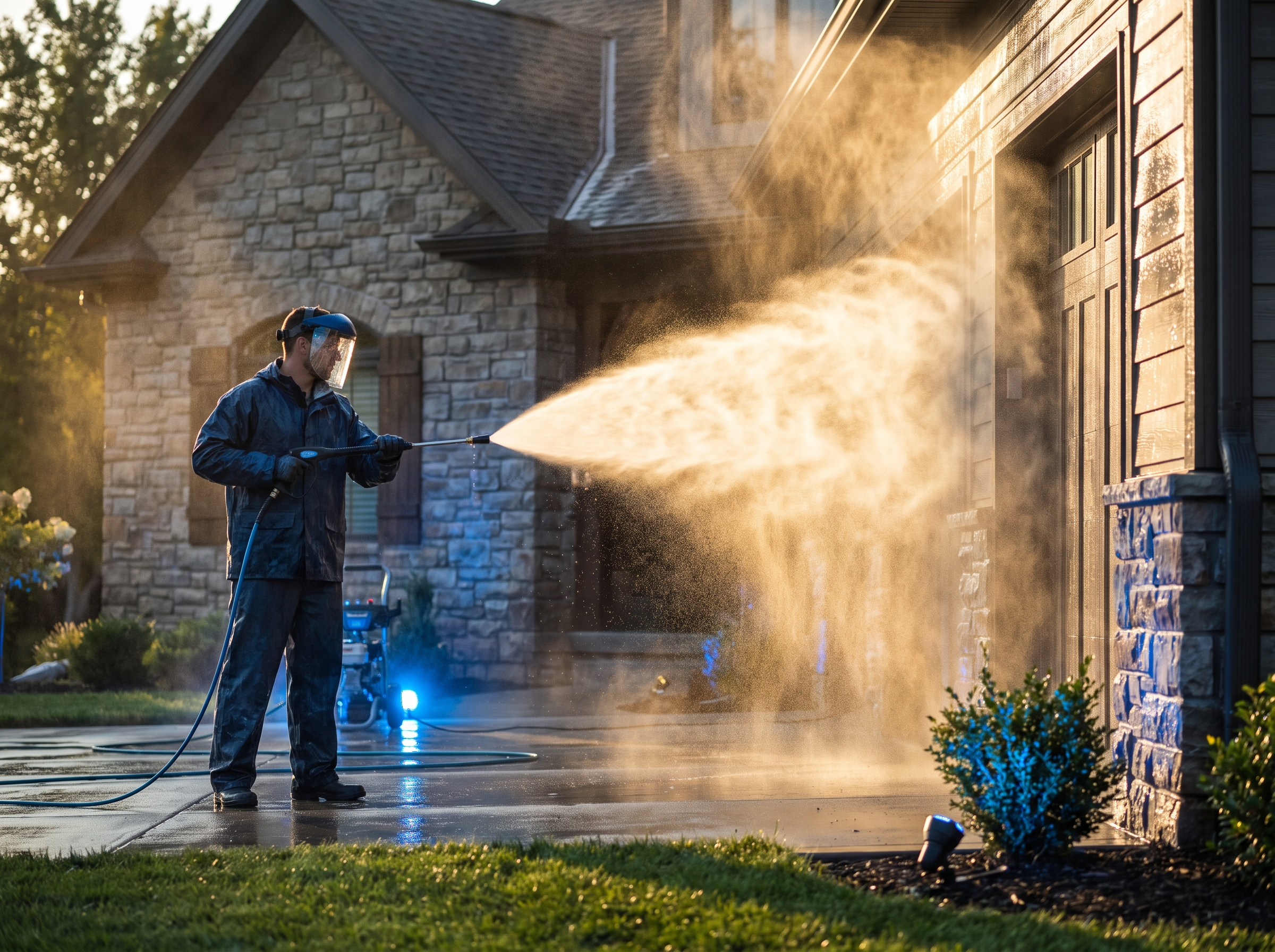
Most pressure washing owners quote by feel, then wonder why some jobs make money and others eat a Saturday. A square-foot rate gives you a repeatable starting point, and a published range gets customers to the estimate already knowing the ballpark. Here is how to build both.
Why square footage works, and where it breaks
Square footage is the one number a customer can give you in a text and you can verify from a satellite view. It scales across driveways, patios, siding, and fences, so your quotes stay consistent from one estimator to the next.
It breaks when you treat it as the whole price. Two 1,200 sq ft driveways can be completely different jobs: one is lightly dirty concrete next to a spigot, the other is oil-stained pavers with polymeric sand that has to be redone. So use square footage as the base, then adjust for conditions.
Build your rate from your costs, not the competitor's website
Start with the hourly number your crew needs to earn on site. Then divide by how fast the crew actually works on each surface.
Say your two-person crew needs to bill $150 per on-site hour to cover labor, truck, fuel, equipment wear, insurance, overhead, and profit. These production speeds are made up for illustration, so time your own crews:
| Surface | Say the crew cleans | Rate at $150/hr |
|---|---|---|
| Concrete driveway or walkway | 400 sq ft/hr | about $0.38/sq ft |
| Vinyl siding (wall area) | 300 sq ft/hr | $0.50/sq ft |
| Patio with pavers | 150 sq ft/hr | $1.00/sq ft |
| Wood deck or fence | 100 sq ft/hr | $1.50/sq ft |
Time three or four real jobs per surface with a stopwatch before you trust any of these. The point is the method: rate = target hourly revenue ÷ square feet per hour.
Set a minimum charge
Small jobs lose money because the truck load-up, drive time, and setup cost the same whether you clean 100 sq ft or 1,000. Say a typical setup and drive eats an hour. Add that hour to a 30-minute job and your minimum is $225 at the $150 rate. Put the minimum in writing everywhere you list prices.
Measure the right square feet
Quotes go wrong when you measure the wrong thing. A few rules:
- Flatwork: length times width, using a satellite view or the customer's photos.
- Siding: wall area, not the footprint. Rough it as perimeter times wall height, then subtract large windows and doors if the house has a lot of glass.
- Decks and fences: decide up front whether you price one side or both, and whether railings and balusters are included.
- Roofs: price by roof surface, not the floor plan, because pitch adds area.
Ask customers for two photos and a rough dimension. That is enough to give a range by text, and you confirm on site before the final number.
Adjust the base price for conditions
Keep your adjustments to a short list so every estimator applies them the same way:
- Height and access: second and third stories, ladders, steep grades, tight side yards.
- Soiling: heavy mold, oxidation, rust, oil, or paint overspray.
- Water and power: no outdoor spigot means you bring your own water, which costs time.
- Add-ons: sealing, sanding, re-sanding pavers, window rinse, gutter brightening.
- Distance: a surcharge past a set drive time from your yard.
Use a flat percentage or flat dollar amount for each one. Decide the numbers once, not job by job in the driveway.
Show ranges online instead of hiding your prices
A range works because it is honest about the thing customers can't see yet, which is the condition of their property. Build it from your own math:
- Low end: easy conditions, single-story, clean access, minimal staining.
- High end: hard conditions, tall or tight access, heavy soiling.
- Wording: state what moves the price, and say the final number comes after photos or a site visit.
Say your 1,500 sq ft vinyl-sided house works out to $0.50/sq ft at the base. That is $750 at the low end. If a third story and heavy mold add 40%, the high end is $1,050. So the page says something like "Most houses this size land between $750 and $1,050," followed by the reasons it could land outside that.
Where to publish ranges
- Service pages on your website: one page per service, each with its own range, minimum, and "what affects the price" list. Our web design for gutter and pressure washing companies page covers the page types that tend to work.
- Google Business Profile: as of 2026, Google's help page says you can add info such as price and description to each service you list in the services editor. Third-party guides say pricing is optional and you can set a fixed price or a range. Details change, so check the Google Business Profile help page when you edit. Our Google Business Profile checklist for contractors walks through the rest of the profile.
- Ads and social posts: use "from" pricing only if you will honor it on a real job, not as bait.
If you list a price, make sure you will actually perform at it. Customers screenshot these things.
Get the paperwork right
A range is marketing. The number a customer signs is a written estimate or contract.
Massachusetts has a Home Improvement Contractor law. As of 2026, the state says contractors who solicit, bid on, or perform work on existing owner-occupied, non-commercial properties with one to four units must be registered, and work estimated at $1,000 or more needs a written contract with required provisions. The regulation, 201 CMR 18.05, calls for a detailed description of the work and the total amount agreed to be paid, among other items.
Whether a given pressure washing job counts as home improvement can depend on the scope, such as washing versus prep for painting or repairs. I'm not a lawyer, so confirm with the state's HIC contractor resources or an attorney. Either way, a written scope that lists surfaces, square footage, add-ons, and the total protects you.
Follow up on the range
A visitor who sees $750 to $1,050 and still sends a photo is a real lead. Reply fast, give a firm number, and follow up if they go quiet. Our guide to an estimate follow-up sequence for contractors has the timing, and tracking where your leads come from shows you which pages and profiles produce the quote requests.
Pricing is also where recurring work starts. Gutter cleaning and annual house washes lend themselves to repeat schedules, covered in gutter cleaning for recurring customers.
Turn your pricing rules into a quote tool
Once your rates, minimums, and adjustments are written down, they can run as a form. A simple version asks for:
- Service type and surface
- Approximate square footage, or an address for a satellite measurement
- Stories and access difficulty
- Soiling level, with photo upload
- Add-ons
The tool applies your rates and shows a range. It also sends you the details and photos, so you are not typing the same questions back to every inquiry. Build in a rule for jobs under your minimum and a "call us" path for odd properties. For the mechanics and pitfalls, read our post on instant quote calculators for your website.
How RGS can help
If you want your pricing rules turned into a working quote form with your rates, minimums, and photo uploads, that is what our custom tool building service is for. We also build the website pages that publish your ranges, and you can see how we work with gutter and pressure washing companies. Call (617) 877-5608 or get in touch.